
Normandy is a big region with a lot to see. Most of these books cover the same core spots, like the D-Day beaches, Mont-Saint-Michel, and the old towns. The real split is how each one handles that ground. Some go deep on history, some give you short lists, and some fit into a bag.
Verdict
Most of these guides cover the same places, so the choice comes down to how you like to travel. Some give you broad coverage across the whole region. Others zoom in on the beaches or the battlefields. Pick based on whether you want the big picture, a quick read, or deep history.
Best overall: Normandy Travel Guide Rouen Honfleur. Its title promises coverage from Rouen and Honfleur to Bayeux, Mont-Saint-Michel, and the D-Day beaches.
Best for a quick trip: DK Top 10 Normandy. Its title says it’s built around top 10 lists and a folded map, which suits a short visit.
Best for history buffs: Normandy ’44. Its title points to the full 77-day battle, so it fits readers who want the story behind the sites.
The rest of this guide is for travelers who want to match a book to their trip.
How We Picked
We looked at a set of Amazon listings for Normandy travel books and battlefield guides. To earn a spot, a listing had to clearly show what the book covers and who it’s for. We dropped any title that looked like a duplicate or didn’t match the region. The final ten each bring a clear angle to the list.
The first filter was the title itself, because that’s where most listings tell you what a book is about. A title that names specific places, such as Rouen, Honfleur, the invasion beaches or Mont-Saint-Michel, tells you the book has a defined route. A title that promises only “Normandy” can mean anything from a town guide to a military history, so we looked harder at those before deciding.
Next we compared the listings on their own stated specs. Several were close to identical, and keeping both would have given a reader two choices that did the same job. When two books seemed to cover the same ground for the same kind of traveler, we kept the one whose title was more specific.
The last check was fit. We asked whether a reader planning a Normandy trip would reach for this book first, and whether it would still be useful once they arrived. A title that drifted into other parts of France, or into gift and picture-book territory, didn’t meet that bar.
Comparison Table
All 10 products side by side — scroll sideways to see every column.
| Top Pick | Best for Short Trips | Best for Quick Reads | Best for Families | Best for Battlefield Maps | Best for Memorials | |||||
| Preview | 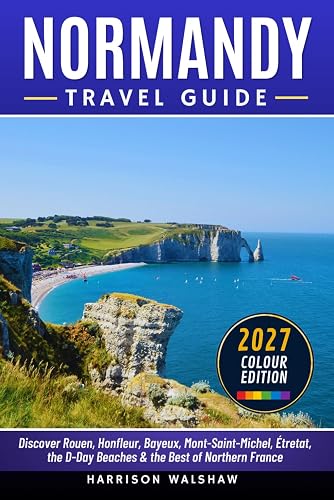 |  |  |  |  |  |  |  |  |  |
|---|---|---|---|---|---|---|---|---|---|---|
| Product | Normandy Travel Guide Rouen Honfleur | DK Top 10 Normandy | Rick Steves Snapshot Normandy | Traveling Professor's Guide Invasion Beaches | Frommer's Normandy with Your Family | Major and Mrs Holt Battle | Normandy '44 D-Day Battle for | Normandy D-Day Travel Guide 2026-2027 | The D-Day Visitor's Handbook | D-Day Landings Travel Guide |
| Best for | Top Pick | Best for Short Trips | Best for Quick Reads | — | Best for Families | Best for Battlefield Maps | — | — | — | Best for Memorials |
| More information | Price on Amazon | Price on Amazon | Price on Amazon | Price on Amazon | Price on Amazon | Price on Amazon | Price on Amazon | Price on Amazon | Price on Amazon | Price on Amazon |
1. Normandy Travel Guide Rouen Honfleur
Best for: Travelers who want broad coverage of the whole region.
This guide’s title names Rouen, Honfleur, Bayeux, Mont-Saint-Michel, the D-Day beaches, and the north of France. That makes it the most far-reaching pick here. If you’re building a trip across several towns, one book covering all of them saves you from buying three.
The listing gives only the title, so we can’t say how deep each section goes. A broad book can trade depth for range. You may want a more focused guide once you know which spot you want to spend the most time in.
Pros
- Covers many regions and towns in one book
- Names Mont-Saint-Michel and the D-Day beaches
- Useful as a first book for a new trip
Cons
- Listing shows only the title, so depth is unclear
2. DK Top 10 Normandy
Best for: Short trips and quick planning.
The title says this book is built around top 10 lists and includes an all-weather folded map. That format suits someone with a few days who wants the highlights without a long read. The map is handy when you’re walking through a town and don’t want to pull out your phone.
A highlights-only format will not cover every smaller place. If you want to wander off the main path, pair this with a book that has more detail, like the Frommer’s or Rick Steves title below.
Think of the lists as a starting point rather than a full plan. Pick the items that match your interests, then check the map to see which ones fall in the same area so you aren’t crossing the region twice in the same visit.
The title describes the map as all-weather, so it is meant to hold up outdoors in changing conditions.
Pros
- Highlight lists make planning fast
- Includes a folded map
- Fits well in a day bag
Cons
- Lists focus on highlights and skip smaller spots
3. Rick Steves Snapshot Normandy
Best for: Readers who want a short, easy read.
This title pairs Normandy with Mont St-Michel and Brittany, so it covers a stretch of the coast that extends further. The “Snapshot” name suggests a compact book, which means less time reading and more time on the road.
The Snapshot name suggests a compact book, though the listing doesn’t say how much detail it includes. Choose it if you want an overview, not a full history of each town.
The practical question is whether you want the book to plan the whole trip or just to orient you. Because this one covers Brittany alongside Normandy, it works best if you already know roughly how far west you plan to travel. If your route stays close to the D-Day coast, a title focused on Normandy alone will give you more of what you need for the same amount of reading.
Think about when you’ll read it. A compact book suits a few evenings before the trip or a quick check on the train. It’s less useful as your main reference once you’re standing at a site and want detail you can look up on the spot.
Pros
- Compact format for a quick read
- Covers Mont St-Michel and Brittany
- Easy to carry on a trip
Cons
- Shorter format means less depth per place
4. Traveling Professor’s Guide Invasion Beaches
Best for: Visitors who want to focus on the D-Day beaches.
This guide is built around the Normandy invasion beaches. Its title calls it a practical travel guide, which suggests it gives you how to get there and what to see at each beach.
If your main goal is the landing sites, this is the most direct choice here. Start by deciding which beaches matter most to you, then see whether the guide’s coverage matches that list before you buy.
It’s less useful if you also plan to visit cities like Rouen or Caen, since the focus is narrow. A battlefield-only guide will leave you without the context you need for a trip that mixes history with towns and everyday sightseeing. In that case, pair it with a broader regional guide from the list above rather than relying on this one alone.
5. Frommer’s Normandy with Your Family
Best for: Families planning a trip together.
The title promises charming villages and the best beaches, written with families in mind. That makes it a good fit for trips with kids who need activities and simple planning, not just history.
The listing doesn’t say how much of the book covers history, so it may suit families who want a fun trip more than a deep study of the battles. The useful test is what your group wants from each day. If the kids will tire of long explanations at a memorial, a book built around villages, beaches and easy outings will keep the trip moving. If your older children or adults have asked to understand the landings in detail, this title may leave that need open, and you would be better served by one of the battle-focused guides listed below.
Think about how the book will be used on the road. A family guide is most helpful when it turns into a plan: which village to stop in, which beach to walk, and how long each stop takes with children in tow. Check that the book gives that kind of day-to-day structure before you buy, because the listing alone doesn’t confirm it.
Pros
- Written with families in mind
- Covers villages and beaches
- Part of a known series
Cons
- Less focus on battle history
6. Major and Mrs Holt Battle
Best for: Readers who want a battlefield map.
This is a map, not a full guide. Its title says it shows the Normandy D-Day landing beaches, so it works best when you already know which sites you plan to visit. A map helps you see how the beaches connect and where the key points sit.
The map is most useful at the planning stage. Spread it out before you book, and trace the route between beaches so you can judge how long the drives will take. Seeing the beaches side by side makes it easier to decide which ones deserve a full morning and which you can visit in passing.
It’s less useful if you’re still deciding where to go. A map shows you the layout of the landing beaches, but it can’t tell you which ones matter most to your interests. If you’re unsure, read a guide first, then use this map to fill in the geography.
Since it’s a map, it won’t give you sightseeing tips or hotel ideas. Pair it with a travel guide if you need that.
Pros
- Shows the D-Day landing beaches clearly
- Useful for planning battlefield routes
Cons
- A map, so no sightseeing or hotel details
7. Normandy ’44 D-Day Battle for
Best for: History lovers who want the full story.
The title points to the 77-day battle for France, so this book is built around the history rather than a sightseeing list. It suits readers who want to understand what happened before they visit the beaches and memorials.
If you want practical tips on where to eat or sleep, this is the wrong pick. It’s a history book first.
Pros
- Covers the full 77-day battle
- Gives context for the sites you visit
- Strong fit for history readers
Cons
- Not a travel guide for practical planning
8. Normandy D-Day Travel Guide 2026-2027
Best for: Travelers who want current itineraries.
The title lists D-Day beaches, museums, memorials, battlefields, travel tips, and itineraries, and gives dates for 2026 to 2027. That makes it the most current pick here. Itineraries help if you want a plan for each day.
Look for whether the routes give you times, distances, and stops in order, or only a list of places to visit. A plan with those details saves planning time. A loose list of sites is more useful if you already know how you want to spend your days.
The title also says the book covers regions as well as the beaches. If you plan to travel beyond the landing sites, confirm that the regional coverage reaches the towns and routes you have in mind.
Dated titles like this one go out of date as sites change hours and access, so the year on the cover is a helpful sign of recency. Still, check any opening times or booking details against official sources before you travel.
Pros
- Includes itineraries
- Covers museums and memorials
- Dated for the coming years
Cons
- Itinerary depth is unclear from the listing
9. The D-Day Visitor’s Handbook
Best for: Battlefield visitors who want a handbook.
This is an 80th anniversary edition, and its title says it covers the Normandy battlefields and WWII Paris. That gives it a scope that goes beyond the beaches alone. If your trip takes you from the coast into the capital, one book can serve both stops instead of splitting your reading across two guides.
The “revised and updated” line suggests the content has been refreshed. The listing doesn’t say what was changed, so you can’t tell from the title alone whether the updates touch the parts of the story you care most about.
Because the listing says nothing about page count or layout, the best test is to look inside before you commit. Check whether the battlefield sections are arranged in a sequence you can follow on the ground, and whether the Paris material is laid out separately enough to skip if your plans stay in Normandy.
Pros
- Covers the battlefields and WWII Paris
- Updated edition
Cons
- Layout and length aren’t stated in the listing
10. D-Day Landings Travel Guide
Best for: Visitors who want beaches and memorials.
This guide covers Normandy’s beaches and battlegrounds, plus sites, museums, and memorials. Its title is focused on the D-Day story and the places that tell it, so it works well for a memorial-focused trip.
The fit comes down to what you plan to do on the ground. If your days are built around standing on the sand where the landings happened, walking the battle sites, and visiting the memorials, this guide keeps you pointed at those places. The listing gives no feature details beyond its title, so check the table of contents or a sample page before you buy to confirm how much space goes to each beach and each museum.
If you also want the region beyond the battlefields, like Rouen or Honfleur, a broader guide will serve you better. This one is designed around the invasion story, so it won’t help you plan days in the cities or along the coast away from the battlegrounds.
Pros
- Covers beaches, battlegrounds, and memorials
- Includes museums and sites
Cons
- Narrower than a full regional guide
How to Choose the Best Things to See in Normandy in Sixty Seconds
Decide how wide your trip is
If you’re touring the whole region, a broad guide saves you from buying several books. If you’re only visiting the beaches, a narrow guide keeps the content relevant. Match the book to your route, not to the page count.
Ask yourself which places are actually on your itinerary. A title that lists Rouen, Honfleur, Bayeux and Mont-Saint-Michel is built for a trip that moves across the whole region, while a title centered on the D-Day beaches is built for a trip that stays on the coast. Buying the broader book for a beach-only visit means paying for pages you’ll never open on the road, and buying the narrow one for a broad tour means switching books halfway through.
Choose depth over length
A short book is quick to read, but it leaves out details. A longer history book gives context but can feel slow on a trip. Think about whether you want to read on the road or plan before you leave.
If you plan to read at home, a longer book rewards the time. If you’ll consult it at a museum or a cemetery gate, you need something you can find a page in within seconds.
Check the format
A folded map, a battlefield map, and a full handbook each serve a different job. If you’ll be walking the beaches, a map may be more useful than a long text. Look at the format before you order.
A folded map is the easiest thing to keep open in a car or on a bench, while a handbook suits a traveler who wants to stop and read each site in turn. The listings here give only titles, so check the physical size and layout of any book you’re considering before you commit.
Closing
Your choice comes down to what you want from the trip, and the guides in this list are built for different kinds of travelers. Coverage of the full region points you toward a guide that spans the whole area, so you can plan a route from Rouen and Honfleur through to the beaches and Mont-Saint-Michel. A short stay favors a guide built around ranked lists, which lets you pick the highest-value sites quickly. A reader who wants the battle itself, not just the sights, should look for a title that tells the story of the campaign in sequence, because that structure helps you understand why each site matters.
Think about how you’ll use the book on the ground. A guide you read on the train before the trip is a different purchase from one you carry on a bus between beaches. If you’ll be checking opening hours and directions mid-day, prioritize a guide with clear, easy-to-scan entries over one with longer narrative chapters.
If your trip is mainly about the landing beaches, a dedicated battlefield guide will serve you better than a general travel book, since it will cover the sites in the order you’re likely to visit them. If you’re traveling with children or planning a relaxed holiday with time for food and villages, a broader guide with family and town coverage is the safer pick.
Before you buy, check the edition year against your travel dates, then sketch a rough day-by-day route so you know which sections of the book you’ll actually need.
Frequently Asked Questions
Do I need a separate book for the D-Day beaches?
Not always. A broad guide may cover the beaches in a section, but a dedicated book gives you more detail on each site. If the beaches are your main goal, a focused title like the Traveling Professor’s Guide or D-Day Landings Travel Guide will go deeper. For a quick overview, a broad guide is enough. Think about how much time you plan to spend at the landing sites before you decide.
Which book is best for a short trip?
DK Top 10 Normandy is built for quick planning, with lists of highlights and a folded map. Its format suits a few days in the region. Rick Steves Snapshot Normandy is also short and easy to carry. Both help you pick highlights fast, though neither gives the depth of a full guide. Choose the one whose format you prefer.
Are these books up to date?
Some are. Normandy D-Day Travel Guide 2026-2027 is dated for the coming years, and The D-Day Visitor’s Handbook is an updated 80th anniversary edition. Others don’t say when they were published. Check the publication date on the listing before you buy, since travel details like opening hours may be out of date if the book is older.
Is a map enough for visiting the beaches?
A map helps you find the sites and plan routes, but it won’t tell you what to see or where to stay. Major and Mrs Holt Battle is a good companion for the beaches, paired with a travel guide for practical tips. A map alone works if you already know the history and only need directions between sites.