Choosing a garden hose timer comes down to how much control you need and how often you want to change batteries. While some models offer simple, mechanical dials for quick tasks, others provide sophisticated scheduling, multi-zone management, or smartphone connectivity to handle complex landscapes. The best choice depends on whether you value ease of use, durability against the elements, or the ability to manage your irrigation remotely.
Best overall: Orbit Digital Hose Timer, which provides a reliable, battery-powered solution with an easy-to-read screen and a generous limited warranty for those needing dependable, straightforward watering control.
Best for smart control: Orbit B-hyve Smart Timer, which uses app-based Bluetooth management and weather-sensing technology to automatically adjust schedules based on local conditions, perfect for those who want hands-off, efficient irrigation.
Best for simple use: Orbit Mechanical Timer, which requires no batteries and uses a straightforward clockwork dial, making it the ideal choice for gardeners who want to avoid electronics and complex setups.
This guide is for anyone looking to simplify their garden maintenance while saving time and water.
How We Picked
We compared 48 different Amazon listings to find the most capable timers on the market. To earn a spot here, a product had to provide clear specifications regarding its power source, zone capabilities, and any special features like rain delay or material construction. We prioritized models that clearly stated their warranty periods and provided enough technical detail to help a homeowner understand their installation. Any product that lacked basic operational details or failed to provide clear information on its primary function was excluded from our final selection.
All 10 products side by side — scroll sideways to see every column.
| Top Pick | Best for App Control | Best for Dual Zones | Best for Manual Use | Best for Large Gardens | Best for Solar Power | Best for Smart Homes | ||||
| Preview |  |  |  |  |  |  |  | 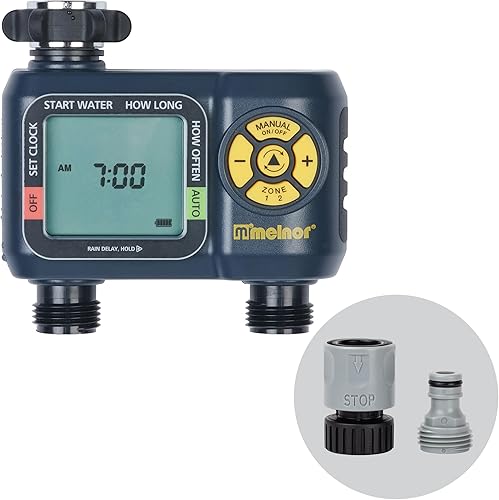 |  |  |
|---|---|---|---|---|---|---|---|---|---|---|
| Product | Orbit Digital Hose Timer | Orbit B-hyve Smart Timer | RAINPOINT 2-Zone Timer | Orbit Mechanical Timer | RAINPOINT Brass Inlet Timer | RAINPOINT 4-Outlet Timer | RAINPOINT Solar Timer | Melnor AquaTimer Digital | meross WiFi Water Timer | Dramm ColorStorm Timer |
| Brand | Orbit | Orbit | RAINPOINT | Orbit | RAINPOINT | RAINPOINT | RAINPOINT | Melnor | meross | Dramm |
| Best for | Best Overall | Best for App Control | Best for Dual Zones | Best for Manual Use | — | Best for Large Gardens | Best for Solar Power | — | Best for Smart Homes | — |
| The listing says | Single outlet automatic hose timer Adjustable irrigation duration | Dual outlet smart hose timer App controlled via bluetooth | IP65 waterproof with upgraded valves Two independently programmable zones | Mechanical hose faucet timer Battery-free clockwork shutoff mechanism | Brass inlet and outlet with 116psi capacity Watering duration from 1min to 3h59min | Four independent programmable zones Adjustable run time 1min to 3h59min | Solar powered with 21-day battery life Brass inlet and outlet with IP65 rating | Two valves for separate zone scheduling Frequency up to 24 times daily | Hub required for remote control Requires 2.4GHz network connection | Automatic shutoff saves water Mechanical battery-free operation |
| More information | Check Latest Price on Amazon | Check Latest Price on Amazon | Check Latest Price on Amazon | Check Latest Price on Amazon | Check Latest Price on Amazon | Check Latest Price on Amazon | Check Latest Price on Amazon | Check Latest Price on Amazon | Check Latest Price on Amazon | Check Latest Price on Amazon |
1. Orbit Programmable Digital Hose Watering Timer
Best for: Homeowners wanting a reliable, standard automatic watering system.
The Orbit Digital Hose Timer turns a standard faucet into an automated system using a single-outlet design. The LCD screen makes it easy to set up your irrigation schedule, helping you maintain a healthy garden without constant manual intervention.
If you have a single garden bed or lawn area, this timer provides the consistency needed for plant health. However, if your landscape requires different watering frequencies for separate zones, you’ll need multiple units. This device doesn’t support multi-zone management from a single connection point.
This unit includes a built-in rain delay, which allows you to pause your set schedule when the weather turns wet. Using this feature prevents water waste during storms. You should check the display periodically to ensure the battery-powered unit remains active.
A common mistake is failing to account for the battery life before a long vacation. If the screen goes dark, the timer stops. Always replace the batteries at the start of the season to avoid dry spells.
Pros
- Simple LCD screen interface.
- Includes helpful rain delay feature.
- Limited warranty provided.
Cons
- Single outlet limits area coverage.
- Requires manual battery monitoring.
2. Orbit B-hyve XD 2-Port Smart Hose Watering Timer
Best for: Tech-savvy gardeners who want remote, weather-based control.
The Orbit B-hyve Smart Timer offers dual-outlet control that you can manage through a smartphone app via Bluetooth. It uses intelligent weather data to adjust your watering, which helps conserve water during drought conditions.
If you live in an area prone to dry spells, the Smart WeatherSense technology is your primary tool. It automatically scales back your watering schedule when local weather data indicates rain or high humidity.
This timer is built with a weatherproof housing, making it durable for outdoor use throughout the seasons. It isn’t suitable for those who prefer manual, button-based programming without the use of a smartphone or app. Relying on the app is mandatory for full configuration, so ensure your device stays within Bluetooth range during setup.
If you experience hardware failure, you’re covered by a two-year limited warranty for private use. This protects against material or workmanship defects, provided the unit was installed according to outdoor-ready specifications.
Pros
- Convenient smartphone app management.
- Smart weather-sensing technology included.
- Reliable dual-outlet irrigation control.
Cons
- Requires app for full control.
- Bluetooth range limits remote configuration.
3. RAINPOINT 2-Zone Timer
Best for: Gardeners managing two separate areas from one faucet.
The RAINPOINT 2-Zone Timer allows you to create individual watering schedules for two different zones. This helps keep various plant types healthy with specific water amounts while conserving resources. You can program durations from 1 minute up to 3 hours and 59 minutes, with frequencies ranging from hourly to weekly.
The unit features upgraded valves that reduce flow resistance by 40% and an IP65 waterproof rating. It has passed 20,000-cycle lab testing, ensuring it stands up to typical outdoor weather. The 360° rotating interface simplifies installation, but verify your faucet is a standard 3/4″ size. If your pipe or faucet is rusted, it may result in a loose connection and reduced compatibility.
The 2.5-inch LED display shows your next irrigation plan and battery status. If the battery runs low, a warning notice appears, and the valve automatically closes to prevent issues. Use the “Zone” button to switch between ZONE1, ZONE2, or both for manual watering. You can also trigger a 24, 48, or 72-hour rain delay to avoid overwatering when the weather turns.
This timer may not be the right choice if you only have a single, small garden bed. In those cases, the dual-zone functionality adds unnecessary complexity. Always check your faucet condition before purchasing to ensure a secure fit.
Pros
- Two independent, customizable zones.
- High IP65 waterproof rating.
- Clear, easy-to-read LED display.
Cons
- Requires specific 3/4″ faucet compatibility.
- Not ideal for single-zone setups.
4. Orbit Mechanical Water Timer
Best for: Gardeners who want a simple, battery-free device.
The Orbit Mechanical Timer works like a kitchen egg timer, using a clockwork mechanism to shut off your water automatically after a set time. Because it doesn’t use batteries or electronics, it’s incredibly reliable for basic, repetitive chores like filling a pool or watering a small patch.
Use this device when your primary goal is preventing water waste during manual tasks. If you need to set a specific duration between 15 and 120 minutes, rotate the dial to the desired mark. The system handles the rest by cutting off flow once the clockwork cycle concludes.
The dial is oversized and designed to be gripped easily, even when your hands are wet or you’re wearing gardening gloves. It isn’t for users who need a complex, multi-day, or multi-zone automated schedule. If you require watering to occur on specific days of the week while you’re away, this mechanical model won’t suffice.
Many users mistakenly assume this timer manages long-term irrigation cycles. Attempting to use it for complex, recurring schedules often leads to frustration. If you need a set-it-and-forget-it system for an entire month, look toward electronic alternatives instead.
Pros
- No batteries required ever.
- Simple, intuitive dial control.
- Limited warranty included.
Cons
- No automated weekly scheduling.
- Limited to a maximum duration of 120 minutes.
- Requires manual interaction for every watering session.
5. RAINPOINT Sprinkler Timer with Brass Inlet & Outlet
Best for: Users prioritizing heavy-duty construction and durability.
The RAINPOINT Brass Inlet Timer features pure brass inlet and outlet ports, providing a strong, corrosion-resistant connection that handles water pressure up to 116psi. Its shell is built with UV-resistant, heavy-duty materials designed to survive long-term exposure to the sun.
The unit includes a built-in metal filter gasket to catch sediment before it enters your irrigation system. If you notice a drop in water flow, check the gasket for debris; cleaning it prevents pressure buildup that could damage the internal seals.
Programming allows for durations between 1 minute and 3 hours and 59 minutes, with frequencies ranging from hourly to weekly. Use the rain delay feature to pause schedules for 24, 48, or 72 hours during wet weather. If you need to water outside your set routine, the manual mode allows for up to 8 hours of flow without erasing your saved settings.
Pros
- Durable brass inlet and outlet.
- Weatherproof and UV-resistant construction.
- Built-in sediment filter gaskets.
- Flexible scheduling for drip or sprinkler systems.
Cons
- Heavier than standard plastic models.
- Requires manual filter maintenance to ensure longevity.
6. RAINPOINT 4-Outlet Timer
Best for: Large gardens requiring multiple, separate watering zones.
The RAINPOINT 4-Outlet Timer provides four independent zones, allowing you to tailor the watering frequency and duration for four distinct areas of your yard. You can set each zone to run from 1 minute up to 3 hours and 59 minutes, with cycles ranging from every 8 hours to once a week. This flexibility ensures your lawn gets exactly what it needs without overwatering.
The large 3.4-inch screen and rotating dial make it simple to program each zone without digging through complicated menus. If you see rain in the forecast, use the rain delay to pause your schedule for 24, 48, or 72 hours. This prevents waste and keeps your utility bills lower.
The manual watering mode lets you wash your car or clean a patio for up to 8 hours without disrupting your automatic schedules. Check your clearance before mounting; if your faucet is recessed or tight against siding, you may need a short hose extender to accommodate the brass inlet.
Pros
- Four fully independent watering zones.
- Large, easy-to-read 3.4-inch screen.
- Simple, intuitive programming dial.
- Versatile manual override for cleaning tasks.
Cons
- Large size requires significant faucet clearance.
- Requires standard 3/4” faucet compatibility.
7. RAINPOINT Solar Sprinkler Timer
Best for: Environmentally conscious gardeners wanting to skip battery changes.
The RAINPOINT Solar Timer uses a high-efficiency solar panel to power its operations. By maintaining an ultra-low power consumption of 100mAh, the unit avoids frequent battery maintenance. Under normal watering frequencies, a single full charge lasts up to 21 days.
However, if your faucet is located in a heavily shaded area, the internal battery may struggle to maintain a charge. In that case, you should opt for a battery-only model to avoid irrigation failures.
The device features a high-strength ABS body and brass inlet and outlet ports. These components provide the durability required for long-term outdoor use. With an IP65 waterproof rating, the timer withstands harsh weather conditions reliably.
You can customize your schedule with watering frequencies ranging from 1 hour to 7 days, and durations from 1 minute to nearly 4 hours. Use the rain delay function (24, 48, or 72 hours) to prevent water waste during wet spells. If you need to water your plants immediately, the manual mode allows for instant flow without disrupting your saved program.
Pros
- Solar-powered for 21-day battery life.
- Durable brass inlet and outlet.
- IP65 waterproof rating.
Cons
- Requires consistent sunlight for charging.
- Not suitable for heavily shaded installations.
8. Melnor 65139AMZ AquaTimer Digital Hose Timer
Best for: Gardeners who use quick-connect hose systems.
The Melnor AquaTimer Digital is a two-zone timer that allows for separate schedules, making it easy to manage different watering needs across your yard. It comes with a quick-connect system that lets you snap your hoses on and off in seconds.
If you have a drip irrigation system, utilize the high-frequency setting. You can program the valves to water as often as every hour, reaching up to 24 cycles per day. For established lawns, you can scale back to once-a-week watering on either zone.
Always check your local weather forecast before leaving for an extended period. The rain delay feature pauses your active schedule for up to 7 days, preventing unnecessary water waste. If you notice the display fading, replace the two AA batteries immediately to avoid valve failure. These batteries aren’t included, so keep a spare set on hand to ensure your garden never misses a cycle.
This unit is backed by a 7-year limited warranty. If a valve sticks or the digital interface fails within this window, the manufacturer covers the hardware.
Pros
- Convenient quick-connect bundle included.
- Two separate, programmable valves.
- Flexible daily watering options.
Cons
- Batteries must be purchased separately.
- Requires manual intervention for rain delays.
9. meross WiFi Water Timer
Best for: Remote management via smart home platforms.
The meross WiFi Water Timer allows you to control your garden irrigation from anywhere using your smartphone, Alexa, or Google Assistant. It automatically skips watering cycles based on hyper-local weather data to ensure you aren’t wasting water when it’s already raining, windy, or freezing.
The unit features durable brass connections and provides usage tracking within the app. Because it relies on a 2.4GHz WiFi hub, it isn’t suitable for homes without a stable wireless network. If you already own a hub, purchase the version without one to avoid redundancy. Check your firmware version before setup; the MSH400 hub requires v4.5.35 or higher for HomeKit, while the MSH450 hub is incompatible with HomeKit entirely.
To install the power cells, use a screwdriver to pry the tightly sealed compartment from both sides. Ensure the polarity is correct to avoid power failures. You can customize durations from one minute up to nearly twelve hours. If you forget to turn it off, the device defaults to a 15-minute auto shut-off, though you can adjust this limit in the app.
Pros
- Integrates with smart home voice.
- Weather-based automatic watering skip.
- Tracks water usage in-app.
Cons
- Requires a specific WiFi hub connection.
- Only compatible with 2.4GHz networks.
- Requires manual tools for battery access.
10. Dramm ColorStorm Premium Water Hose Timer
Best for: People who want a reliable, no-fuss manual timer.
The Dramm ColorStorm Timer is a mechanical device that shuts off the water automatically after a set duration, up to two hours. It functions without batteries or electronics, making it a simple, dependable tool for daily garden tasks. Because it works like an egg timer, you never have to worry about dead batteries or corroded terminals.
The timer is available in six bright colors: red, orange, yellow, green, blue, and berry. Use these colors to color-code your zones. If you have multiple hoses connected to your water source, assign one color to your drip system and another to your soaker hose to identify your setup at a glance.
Because it’s purely mechanical, it doesn’t support complex, multi-day, or time-of-day scheduling. This tool is intended for immediate, one-off watering sessions. If you need a system that triggers automatically every morning at sunrise, this isn’t the right choice. Relying on this for automated weekly care will lead to dry plants or missed cycles.
Pros
- Lifetime guarantee provided.
- No batteries ever needed.
- Simple manual runtime for extended watering sessions.
Cons
- Lacks automated weekly programming.
- Requires manual reset for every use.
If you’re prone to forgetting the water is running, this device prevents waste by cutting the flow after your chosen interval. Set it for 120 minutes or less, and it will handle the rest.
How to Choose in Sixty Seconds
Which type of timer is actually best for my garden?
For most small gardens, a digital timer that attaches to a standard outdoor spigot is sufficient. If you have several different plant types, such as a lawn that needs daily watering and a vegetable patch that needs less, a multi-zone timer like the RAINPOINT 2-Zone Timer is a better investment. If you aren’t comfortable with programming digital screens, a mechanical timer like the Orbit Mechanical Timer or the Dramm ColorStorm provides basic automation without the learning curve.
Choose a mechanical timer if you want a “set it and forget it” tool that requires zero batteries. These work like an egg timer, shutting off automatically after a set duration. If your priority is precision, opt for a digital model. These allow you to set specific start times and frequencies, such as watering every 12 hours or once a week.
What should I check before I buy a timer?
First, check the number of faucets you have and the space around them. Some large multi-zone timers are bulky and may not fit if your faucet is close to a wall. Second, look at your power preference. If you hate changing batteries, look for solar-powered units like the RAINPOINT Solar Timer or mechanical models.
Always check your faucet connection. Most residential timers are compatible with standard 3/4-inch faucets. If you’re replacing an old system, check your hose threads for rust, as a clean connection is essential for preventing leaks. If you’re considering a smart timer, verify your WiFi signal strength.
Do I really need smart features?
Smart features are excellent if you travel often or live in an area with unpredictable weather. A timer that uses local weather data to skip cycles, such as the Orbit B-hyve or the meross WiFi Water Timer, can save significant water compared to a fixed schedule.
If you choose a smart device, ensure you’re comfortable using a smartphone app to manage your settings, as these devices often lack the intuitive physical buttons found on simpler, manual models. Note that smart timers require a hub or a stable 2.4GHz network. If you struggle with app-based interfaces, stick to units with large LCD screens and physical buttons, which are designed to be user-friendly for everyone, including those in their seventies.
Once installed, take a few minutes to test the manual override. This ensures you can quickly turn on the water for tasks like washing a car without interrupting your preset irrigation schedules. Check your model for a rain delay feature to pause watering during wet weather.